
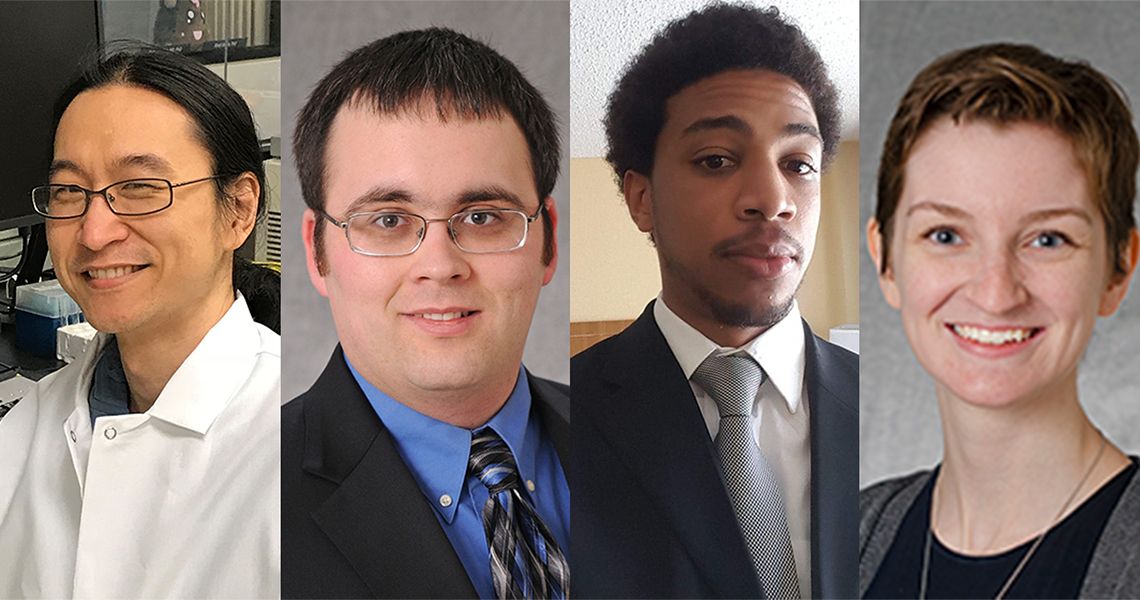
Four young researchers at the George Washington University (GW) School of Medicine and Health Sciences (SMHS) were selected as fellows to the recently awarded five-year National Cancer Institute T32 Training Grant. The grant is led by Norman Lee, PhD, professor of pharmacology and physiology at SMHS and Ed Seto, PhD, associate center director for basic sciences at the GW Cancer Center, King Fahd Professor of Cancer Biology, and professor of biochemistry and molecular medicine at SMHS, and supports the training of junior scientists who will advance research on the molecular and genomic causes, progression, treatment, and relapse of human malignancies.
The training includes key coursework in oncology, research advice from both basic and clinical advisers, and an emphasis on addressing cancer health disparities in the Washington, D.C., region.
“The T32 Fellowship Selection Committee was very impressed by the competitive pool of applications that were received," said Rong Li, PhD, chair of the Department of Biochemistry and Molecular Medicine and Ross Professor of Basic Science Research at SMHS. “After careful review and deliberation, the committee was able to identify the finalists of the pre- and post-doctoral fellowships who exhibit strong academic background, solid training and research plans, exceptional mentors and stimulating training environment. We have every confidence that the T32 Training Grant will facilitate cancer-focused training and career advancement for these next-generation cancer researchers."
Three postdoctoral trainees and one PhD student were selected for the program:
Postdoctoral trainee Kenji Ishida, PhD, mentored by Michael Hsieh, MD, PhD, associate professor of urology at SMHS, is working on a project on helminth parasite-induced carcinogenesis over the course of one-year, with an interest in characterizing mechanisms of parasite-host interactions.
Postdoctoral trainee James McDonald, PhD, mentored by Kate Chiappinelli, PhD, assistant professor of microbiology, immunology, and tropical medicine at SMHS, will embark on a one-year research study into how epigenetic therapies can activate the immune system to improve outcomes for cancer immunotherapy treatments.
Postdoctoral trainee Michael Smith, PhD, mentored by Paul Brindley, PhD, professor of microbiology, immunology, and tropical medicine at SMHS, will transition from parasite-oriented research to the cancer field on a one-year study to apply mechanisms of host responses to address cancer, with a particular interest in cancer health disparities in Washington, D.C.
Graduate student Nicole Bonan, mentored by Rohan Fernandes, PhD, associate professor of medicine at SMHS, was selected for a two-year fellowship to develop methods to increase immune cell killing of tumor cells with a mesothelioma model system.


